
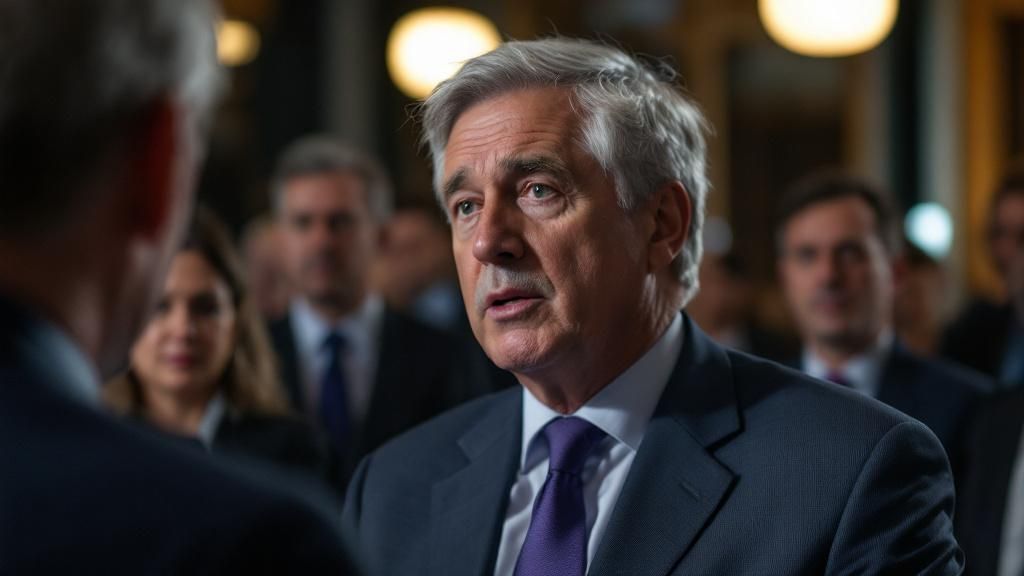
As households nationwide grapple with skyrocketing energy bills and inflation climbing to unprecedented levels, the Labour leader has initiated a biting attack on the Government’s management to the cost-of-living emergency. In a tense Commons clash, the Labour party has scrutinised the administration’s insufficient assistance schemes, calling for more substantial action to help financially stretched families. This article explores the intensifying tensions relating to the crisis and investigates the competing visions for economic relief.
The Opposition party’s Assessment of Government Policy
The leader of the opposition has intensified scrutiny of the government’s handling of the mounting cost-of-living emergency, asserting that current measures fall woefully short of addressing the extent of difficulty facing British households. Throughout parliamentary proceedings, the opposition has articulated a comprehensive critique spanning insufficient financial assistance, insufficient intervention in energy markets, and a perceived lack of commitment to combating inflation. The opposition contends that whilst families struggle with record-high bills, the government’s piecemeal approach simply treats symptoms rather than dealing with fundamental causes of financial hardship.
Central to the opposition’s case is the claim that the government has seriously underestimated both the severity and duration of the crisis. Opposition officials have pointed to figures suggesting that vast numbers of families now endure genuine difficulty, with many forced to choose between warmth and food. The opposition argues that the government’s early action failed to assess the crisis’s consequences, resulting in support mechanisms that turned out to be insufficient when the situation got worse further. This wrong assessment, they argue, reveals wider shortcomings in forecasting accuracy and policy planning.
Insufficient Support Systems
The opposition has directly criticised government support schemes as insufficient and poorly targeted, arguing that fuel cost controls do not adequately safeguard those on lower incomes sufficiently. Observers note that whilst the government has introduced different funding schemes, including grants and council tax rebates, these measures deliver limited reprieve without resolving underlying problems. The opposition contends that eligibility-based assistance remain overly stringent, leaving out millions of families in work who nonetheless struggle with rising costs. Moreover, they argue the government’s approach lacks the determination required to tackle such an unprecedented economic challenge.
Opposition examination indicates that present welfare systems disproportionately disadvantage families on moderate incomes who fall between qualifying criteria for targeted assistance. The party has put forward alternative frameworks incorporating across-the-board allowances, broadened support schemes, and direct government intervention in power industries to control costs. They emphasise that interim steps, whilst welcome, cannot substitute for fundamental systemic change. The opposition maintains that without substantial legislative change and increased public investment, working people will continue experiencing severe money pressures in the coming period.
Extended Economic Policy Challenges
Beyond immediate crisis management, the opposition has raised fundamental questions regarding the state’s long-term economic direction and competitive position. Opposition analysts argue that the present method focuses on short-term political considerations over durable economic planning, possibly undermining Britain’s future economic wellbeing. They contend that without strategic investment in renewable energy systems, manufacturing capacity, and human capital development, the nation risks prolonged economic stagnation. The opposition emphasises that managing cost of living difficulties requires comprehensive reforms targeting productive efficiency, technological innovation, and economic sector development alongside urgent relief measures.
The opposition has articulated concerns that government policy lacks coherence across different economic domains, with energy policy, industrial strategy, and fiscal measures working independently rather than as coordinated elements. Critics argue this piecemeal framework hinders resolution of persistent inflation and structural economic weaknesses. The opposition pushes for a unified national approach encompassing energy transition, manufacturing revival, and skills development. They maintain that real problem-solving necessitates radical policy overhaul rather than gradual modifications to existing frameworks.
Government’s Response and Counter-arguments
The government has steadfastly defended its economic strategy, arguing that the cost of living pressures are primarily driven by worldwide circumstances beyond Westminster’s direct control. Ministers have highlighted the extraordinary scale of the energy crisis, resulting from geopolitical conflicts and international supply chain disruptions. They maintain that their focused assistance measures, covering the price cap on energy and cost of living payments, constitute a prudent and financially sound approach. The Finance Ministry maintains that overspending could exacerbate inflation further, undermining long-term economic stability and in the end harming the same families the opposition professes to defend.
Government representatives have stressed the significant monetary support previously allocated, amounting to billions of pounds in immediate aid to vulnerable households. They contend that their approaches reconcile short-term assistance with prudent fiscal management, averting the cycle of indebtedness that unchecked spending could provoke. Ministers also highlight their work in boosting energy security through sustainable energy projects and market diversification. The government contends that whilst the opposition delivers sympathetic rhetoric, their suggested policies lack financial viability and would prove unsustainable without raising tax rates or increased borrowing.
Furthermore, government officials emphasise their commitment to addressing fundamental economic difficulties through productivity improvements and enterprise investment schemes. They argue that enduring recuperation demands systemic economic transformation rather than temporary handouts. The executive branch considers this approach ultimately delivers enhanced economic wellbeing and security for every citizen.
